Vitiligo Activity Index:
measuring the progression
of vitiligo
Recognize the signs, assign a score, calculate the VAI
What is the Vitiligo Activity Index
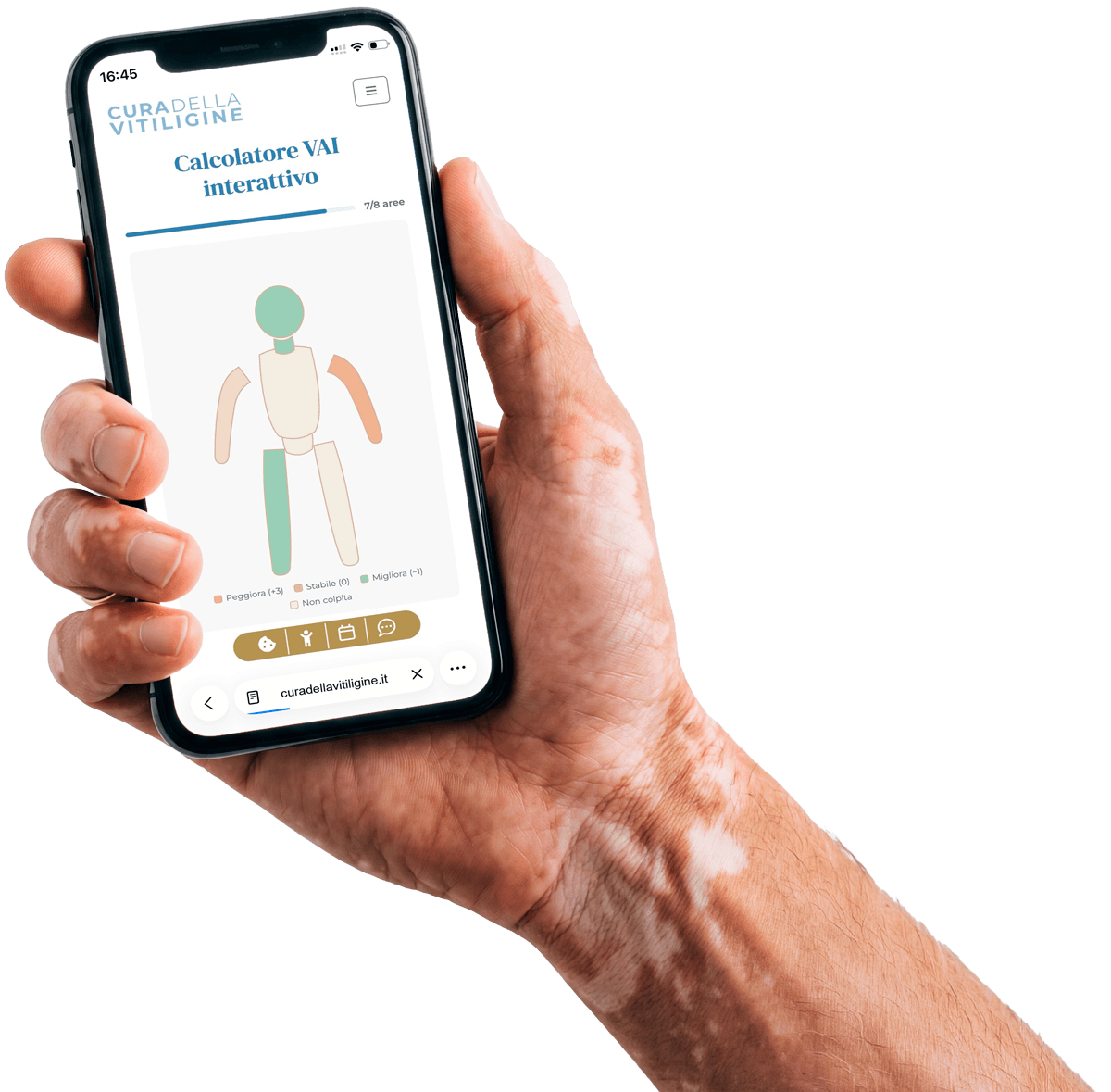
This page helps you recognize the signs by which vitiligo changes over time and translate them into a numerical value: the Vitiligo Activity Index (VAI). This allows you to more easily understand whether the disease is worsening, stable, or improving, and arrive at your appointment with a value already recorded. You will first find a guide to identifying the signs and calculating the score, followed by an interactive calculator that automatically performs the calculation. The VAI does not replace a medical consultation and should not be used to independently choose a treatment: the treatment plan should always be a decision shared with your physician.
The Vitiligo Activity Index (VAI) is a numerical value used to assess the progression of vitiligo over time. This value makes it possible to determine whether the disease is worsening, stable, or improving. It is obtained by dividing the overall activity score (VAS) by the number of affected body areas (VAA), according to the formula VAI = VAS ÷ VAA. The result can range from −1, indicating the greatest improvement, to +3, corresponding to the highest disease activity.
Signs to recognize
To understand whether a vitiligo patch is worsening, stable, or improving, it is enough to observe a few characteristic signs. They are easily recognizable with the naked eye and form the basis of the Vitiligo Activity Index (VAI) calculation. In lighter skin phototypes, especially during winter when the contrast with healthy skin is reduced, a Wood’s lamp can make observation easier.

Punctate depigmentation
WorseningSmall white or lighter spots, approximately 1–2 mm in size, that appear near the edge of a patch or on the surrounding healthy skin. Over time, without treatment, they multiply and merge, causing the patch to expand. They are most commonly seen on the limbs and trunk.

Border delamination
WorseningThe edge of the patch is not sharply defined: the pigmentation gradually fades, creating one or more bands of intermediate color between the white patch and the surrounding healthy skin. This is a sign that the patch is expanding. (Some refer to this as “trichrome” or “quadrichrome” vitiligo.)

Follicular repigmentation
ImprovementSmall spots of normal skin color reappearing within the patch, corresponding to the hair follicles. Over time, they increase in size and merge, gradually restoring pigment to the patch. This is a sign that the area is recovering.

Stationary patch (reference)
StablePatch with sharp, well-defined borders, without surrounding light spots, without border fading, and without areas of normal pigmentation reappearing within it. None of the phenomena described above are present: in that area, the disease is stable.
Practical tip. For areas that are difficult to examine on your own (back, back of the arms and legs, genital area), ask a family member to help you. With good lighting, and a Wood’s lamp if available, these signs can be observed by anyone.
Divide the body into 8 areas
The body is considered divided into eight areas. For each one, you will determine whether it is affected and assign a score.
- Head
- Neck
- Trunk (chest, abdomen, back)
- Genital area
- Right arm
- Left arm
- Right leg
- Left leg
VAA (Affected Areas) = how many of the 8 areas have at least one patch (from 0 to 8). If a patch extends across multiple areas, count all the areas it touches.
Assign a score to each area
To obtain an accurate assessment, it is important to follow the order of the questions below. The VAI calculation gives priority to signs of worsening, then to signs of improvement and, only in their absence, to patch stability.
Are there any signs of worsening?
Look for punctate depigmentation (1–2 mm spots around the patch) or border delamination (a blurred edge with multiple shades). The presence of either one is sufficient.
Only then: are there any signs of improvement?
If there are no signs of worsening, look for follicular repigmentation (spots of normal skin color reappearing within the hair follicles).
No signs of worsening or improvement?
The patches are stable, with sharp, unchanged borders: the area is stationary.
| Score | When to assign it |
|---|---|
| +3 |
First check. The area shows punctate depigmentation or border delamination — even if the same area also contains stable patches or signs of repigmentation. Worsening always takes priority: if it is present, stop here. |
| -1 |
Only if step 1 is no. The area has no punctate depigmentation and no border delamination, but it shows follicular repigmentation (spots of normal pigmentation reappearing within the patch). Improvement only. |
| 0 |
Only if both previous checks are no. The area contains only stationary patches: no signs of worsening and no signs of improvement. |
VAS (Activity Score) = the sum of the scores assigned to all areas. It can range from −8 (all areas improving) to +24 (all areas worsening).
Calculate the VAI
The result ranges from −1 to +3. There is a stability range between −0.5 and +0.5: within this range, vitiligo is considered stable. Above +0.5, it is worsening; below −0.5, it is improving.
Improvement
Stable
Worsening
The further the value falls below −0.5, the more vitiligo is improving; the further it rises above +0.5, the more it is worsening. Values close to zero, within the stability range, indicate a substantially stable condition.
Example. You have patches on the trunk with surrounding spots (worsening → +3), stable patches on the right leg (0), and spots of normal pigmentation reappearing on the left arm (improvement → −1).
Affected areas VAA = 3; sum of scores VAS = +3 + 0 − 1 = +2.
VAI = 2 ÷ 3 ≈ 0.67 → since it is above +0.5, this indicates a slight overall worsening.
Interactive VAI calculator
Tap an area of the body and answer the questions: the calculator assigns the score and automatically calculates VAA, VAS, and VAI.
FAQ
The Vitiligo Activity Index (VAI) is a numerical value that describes the activity status of vitiligo. It helps determine whether the disease is worsening, stable, or improving. It is calculated by dividing the Activity Score (VAS) by the number of affected areas (VAA). The result ranges from −1 to +3.
Yes. The signs needed to calculate the VAI are generally visible to the naked eye; in lighter skin phototypes, a Wood’s lamp may be helpful. For areas that are more difficult to examine, such as the back or the back of the limbs, you can ask a family member for assistance. A VAI calculated at home can help monitor the progression of the disease over time, but it does not replace a dermatological examination or a physician’s therapeutic assessment.
Punctate depigmentation and border delamination are the main signs of vitiligo worsening. Follicular repigmentation, on the other hand, is the most characteristic sign of improvement. In the VAI, values above +0.5 indicate disease activity, while values below −0.5 indicate improvement.
A VAI between −0.5 and +0.5 indicates substantially stable vitiligo, with no clear signs of either worsening or improvement. The trend of the values over time, rather than a single measurement, is what best reflects how the disease is progressing.
Because in the VAI, worsening takes priority. If an area shows punctate depigmentation or border delamination, it is assigned a score of +3 even if signs of repigmentation are also present. For this reason, worsening is always assessed first, and improvement is evaluated only if no signs of worsening are found.
Warnings. This tool is intended to help observe the progression of vitiligo, not to diagnose it or independently change treatment. If you have doubts, rapid worsening, or new symptoms, contact your physician. Recognizing the signs improves with experience: during the first assessments, it is normal to feel uncertain, and discussing them with your dermatologist helps train the eye.
Iscriviti alla newsletter
ImmunoNova