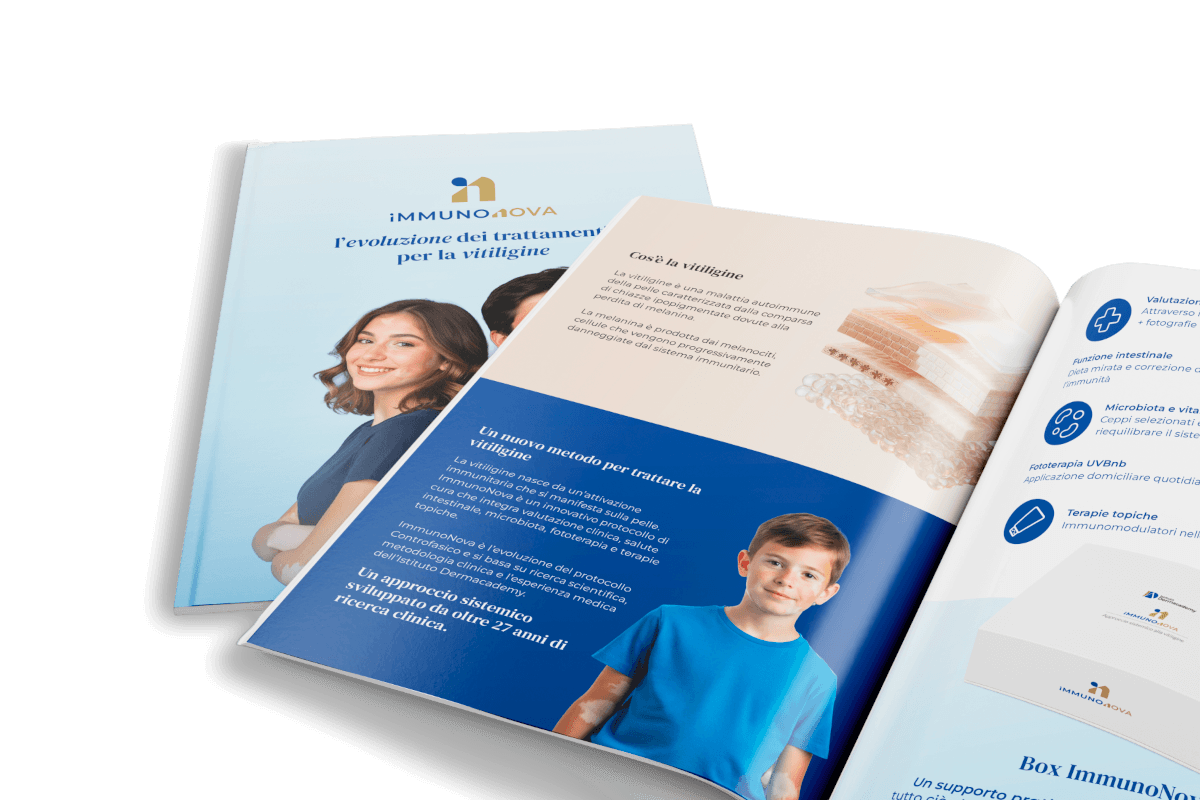

Vitiligo: an autoimmune disease with systemic roots
Vitiligo is an autoimmune disease in which the immune system, due to a recognition error, attacks the melanocytes, the cells responsible for melanin production.
The clinical consequences appear as hypopigmented patches of varying shape and distribution — often on the face, hands, elbows, knees, or genital areas.
Although it is neither contagious nor painful, vitiligo deeply affects the psychological well-being and quality of life of patients.
It is important to remember that the skin is only the visible target of the disease, not its origin. The pathogenic process arises from an imbalance of the immune system, which extends beyond the skin and may involve other systems, such as the thyroid or the intestine.
Why a local approach is not enough
For decades, vitiligo therapy focused on the use of topical creams or narrowband UVB phototherapy, with the aim of stimulating repigmentation.
Although valid, these approaches act only on the symptom. They do not intervene in the autoimmune mechanisms sustaining the disease, which is why relapses and progression remain frequent.
Relying solely on local treatment is like drying the floor while the ceiling continues to leak.
The most recent research and clinical experience agree: vitiligo requires a systemic approach, capable of rebalancing immunity, correcting intestinal dysbiosis, and modulating chronic low-grade inflammation.
From the Controfasico protocol to ImmunoNova: the systemic vision takes shape
The evolution of the research conducted by Dr. Giovanni Menchini and his team led to the creation of ImmunoNova, a proprietary protocol representing the clinical advancement of the previous “Controfasico” approach.
No longer a sequence of isolated interventions, but an integrated therapeutic model based on five pillars, capable of acting simultaneously on the factors driving the disease.
The pathway is organized into a single “evening block” — between dinner and post-dinner — to simplify therapeutic adherence and optimize biological response over time.
Clinical evaluation and activity index (VAI)
Every treatment begins with a complete dermatological evaluation.
Through Wood’s lamp photography and calculation of the Vitiligo Activity Index (VAI), the degree of activity and extent of lesions are determined.
This index, developed by Dr. Menchini in 2007, is now recognized as a tool for monitoring clinical progression and personalizing therapy according to the immune activity of each patient.
Intestine and barrier function
Scientific research has highlighted a strong correlation between intestinal dysbiosis and autoimmune activation.
An inflamed or “leaky” intestine (leaky gut) allows antigens and toxins to pass into the bloodstream, keeping the immune system in a constant state of alert.
Studies such as Fasano’s (2012) confirmed the central role of the intestinal barrier in controlling autoimmunity.
The ImmunoNova Protocol includes a targeted gastrointestinal evaluation and a corrective diet aimed at restoring mucosal integrity.
The goal is to reduce the production of pro-inflammatory cytokines and restore immune balance.
Microbiota and Vitamin D3: immune modulation and melanogenesis
The gut microbiota is a true immunoregulatory organ.
Patients with active vitiligo show a predominance of Th17 cells and increased IL-17, a pro-inflammatory cytokine associated with disease progression.
Supplementation with selected probiotic strains (Lactobacillus paracasei, L. rhamnosus, Bifidobacterium animalis, L. plantarum) contributes to reducing this aberrant response.
Vitamin D3, beyond its well-known role in bone health, regulates immune tolerance and supports melanocyte proliferation.
Serum levels above 60 ng/mL are associated with better repigmentation rates.
Home-based narrowband UVB phototherapy
Narrowband UVB phototherapy is one of the most effective methods in the management of vitiligo.
Used in daily sub-erythemogenic doses, it stimulates melanin production, reduces local inflammatory activity, and promotes melanocyte migration.
In Dr. Menchini’s clinical case series, more than 70% of follow-up visits after home-based UVBnb therapy show significant clinical improvement, even in extensive or difficult areas such as elbows and knees.
Topical therapies: immunomodulation and melanocyte stimulation
Topical therapies are calibrated according to the phase of the disease:
- during active phases: use of corticosteroids or calcineurin inhibitors to modulate the immune response;
- during stable phases: application of melanocyte-stimulating substances, such as Piper nigrum extracts, often combined with phototherapy.
Over the last five years, the Institute has documented more than 23,000 follow-up visits with an average clinical improvement rate exceeding 70%.
Therapeutic adherence and clinical results
In real-world medicine, adherence is crucial.
Within the ImmunoNova Protocol, patients with complete adherence show clinical improvement in 72% of subsequent visits.
The face and trunk areas tend to respond more rapidly (within 3–6 months), while the distal phalanges and hands require longer periods but still achieve appreciable results.
Every area, however, has clinical importance and must be treated consistently.
The substantial difference: from symptom to system
The previous Controfasico protocol represented an important step in therapeutic management, but it still acted in a sequential and predominantly local manner.
ImmunoNova, on the other hand, adopts a systemic vision, integrating dermatology, immunology, and clinical nutrition.
The objective is not only to repigment the skin, but to reduce autoimmune activation, prevent new patches, and improve the patient’s overall health.
In conclusion
Vitiligo is not simply a skin disease, but an external manifestation of a complex immune disorder.
The ImmunoNova Protocol today represents an advanced and scientifically validated therapeutic model, capable of combining clinical evidence, methodological rigor, and personalized care.
Addressing vitiligo means intervening on multiple levels: cutaneous, immune, and intestinal.
Only in this way is it possible to achieve stable and long-lasting remission.